

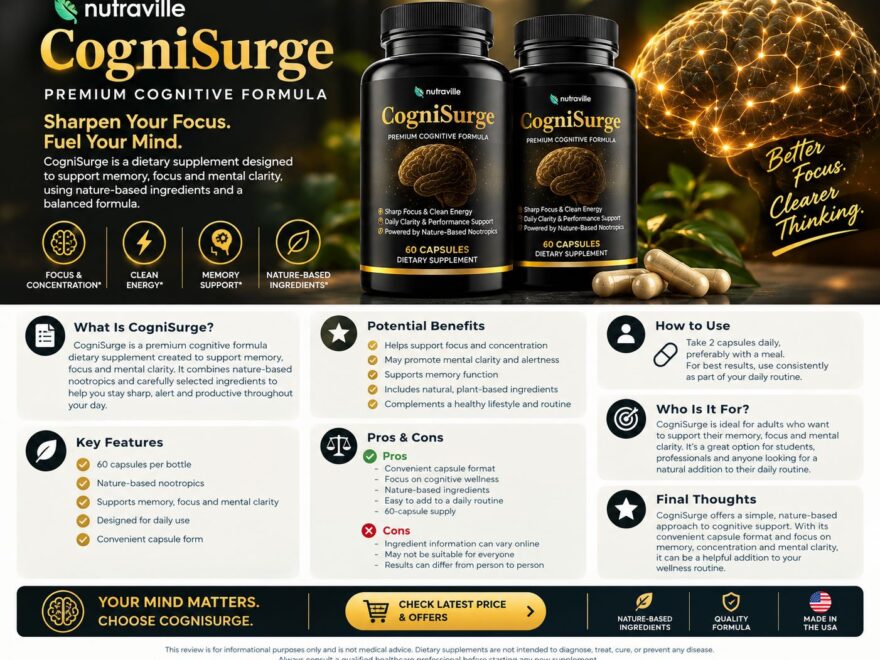
CogniSurge Review: Why This Brain Supplement’s Identity Doesn’t Add Up
A quick search for a CogniSurge review turns up something unusual: the results describe at least three different products under the same name, sold by different companies in different formats. This CogniSurge review focuses on untangling that confusion and pointing out a few concrete red flags worth recognizing, rather than repeating another round of “supports memory, focus, and clarity” marketing copy.
Brain supplements already attract more than their share of vague, unverifiable claims, and CogniSurge is a clear example of how a generic, appealing name gets recycled across unrelated products and marketing networks. Before deciding whether any version of CogniSurge is worth trying, it’s worth understanding exactly what you’re actually looking at.
Why CogniSurge Doesn’t Point to One Single Product
The most important thing to understand about CogniSurge is that the name isn’t tied to one consistent formula. One version is a capsule-based supplement from a company called Nutraville, marketed toward general memory and focus support for adults. A completely separate product, made by Jacked Factory, is a powdered nootropic built around large doses of L-Tyrosine, Lion’s Mane, and citicoline, marketed specifically toward gamers and students who want low-stimulant focus support. A third version appears on other sites describing a “closely guarded formula” with no manufacturer clearly identified at all.
These aren’t variations of one brand — they’re unrelated products that happen to share a catchy, generic name. That matters because reviews, side effects, and pricing for one version can easily get mixed up with a completely different product if you’re not paying close attention to which manufacturer and formula a specific review is actually describing.
A Tell-Tale Sign Hiding in the Product Photos
Here’s a practical tip that applies well beyond CogniSurge: product photos with garbled, misspelled label text are a strong sign of an AI-generated image rather than a photo of a real product. Look closely and you’ll sometimes see label text that reads like “Supports Concentration” but comes out distorted, with letters overlapping or words that don’t quite form correctly. This is a known limitation of AI image generators, which struggle to render clean, readable text.
When a supplement’s marketing relies on an AI-generated bottle image instead of an actual product photo, it’s worth asking why. It doesn’t necessarily mean the underlying supplement doesn’t exist, but it does suggest the marketing material wasn’t built around a real product shoot, which is a meaningfully lower bar than most legitimate brands meet.
- Zoom into any supplement label text in a marketing image and check for warped, overlapping, or misspelled words
- Compare product images across multiple sites — inconsistent bottle designs or label text is a sign of a recycled or AI-generated product identity
- Search the exact manufacturer name printed on the label to confirm it’s a real, registered company

The Recycled Marketing Patterns Worth Recognizing
Beyond the multiple-identity problem, CogniSurge marketing follows several patterns seen across other heavily promoted supplements. At least one promotional PDF was found hosted on a University of Texas academic subdomain, unrelated to supplements or brain health research, suggesting an open upload system was used to publish affiliate content without authorization. Separate pages also contain entire paragraphs duplicated word-for-word within the same article, a clear sign of automated or low-effort content generation rather than genuine, hands-on reviewing.
Several pages also lean on the phrase “brain barrier” or reference protecting the brain’s “glycocalyx” — a real biological structure, but used here in a vague way with no citation connecting it to how the specific CogniSurge formula is supposed to work. Borrowing a real scientific term without a specific, checkable study behind the claim is a common way to make marketing sound more credible than the evidence actually supports.
How to Approach a Product Like CogniSurge Responsibly
If you’re still curious about trying a brain supplement carrying this name, treat it as researching one specific product from one specific, verifiable manufacturer, not a general category. Confirm the exact company, ingredient list, and dosages printed on the actual bottle you’d receive, and disregard marketing describing a different formula sold under the same name.
- Identify which specific company and formula you’re actually looking at before reading further reviews
- Check whether the product photos look AI-generated, with distorted or misspelled label text
- Look for a real, citable study behind any specific claim, rather than scientific-sounding terms used without a source
- Track your own memory, focus, and energy for a few weeks if you decide to try it, rather than relying on marketing testimonials
If memory or focus issues are significant, persistent, or getting worse, that’s worth discussing with a doctor rather than addressing through any supplement, since those symptoms can have underlying causes that deserve a proper evaluation.
This article is for informational purposes only and is not medical advice. Consult a healthcare provider if you’re experiencing significant memory or cognitive changes before relying on a supplement.
Frequently Asked Questions About CogniSurge
Is CogniSurge one single product? No. The name is used by at least three different, unrelated products from different manufacturers, so it’s important to confirm exactly which one a review is describing.
How can I tell if a CogniSurge product photo is real? Look closely at the label text — warped, overlapping, or misspelled words are a common sign of an AI-generated image rather than a genuine product photo.
Why does CogniSurge marketing appear on a university website? Some promotional content was found hosted on an unrelated academic subdomain, suggesting an open upload system was used to publish affiliate marketing without authorization.
What does “protecting the brain’s glycocalyx” actually mean? It references a real biological structure, but the claim as used in CogniSurge marketing isn’t tied to a specific, citable study, so it should be treated as a marketing term rather than established science.
Have you come across a CogniSurge listing with a product photo that looked a little off, or found a completely different formula sold under the same name? Share what you noticed in the comments — and let me know if you’d like a future post on how to spot AI-generated product images before you buy.