

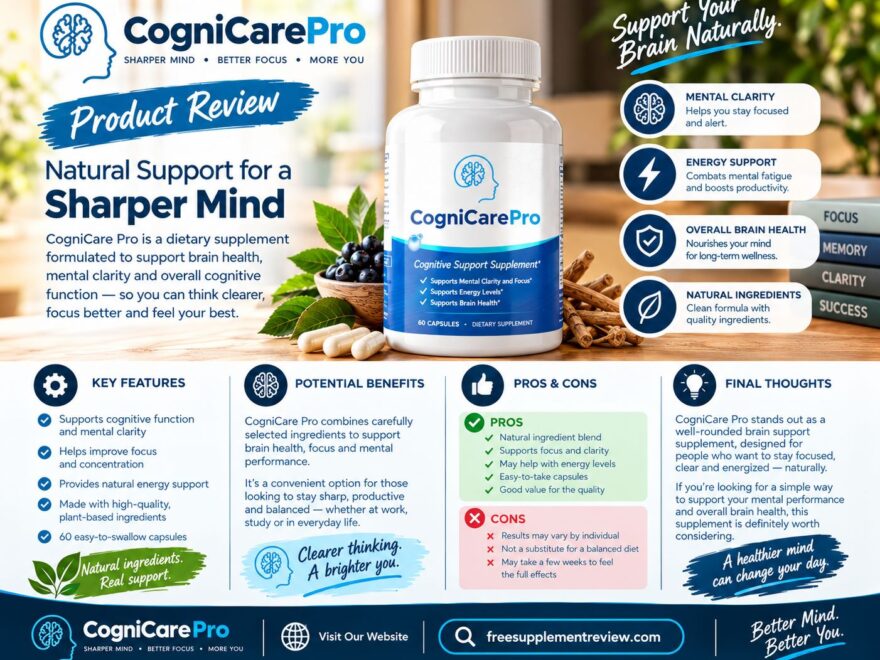
CogniCare Pro Review: Rice Flour, “Durability,” and Other Clues the Reviews Are Unreliable
Memory and focus supplements sell hope, and CogniCare Pro sells it with a clean blue bottle, a brain icon, and promises of clarity, energy, and brain health. This CogniCare Pro review looks at what the label and the surrounding marketing actually say, which ingredients can plausibly help, and why so many of the glowing write-ups you will find online fail basic tests of credibility.
If you are worried about forgetfulness, or you simply want sharper concentration at work, the search results can feel overwhelming. Dozens of pages use the same name and almost the same sentences. That repetition is not proof of popularity. As you will see below, it is a pattern, and learning to recognize it will help you judge far more than this one product.
What CogniCare Pro Claims to Be
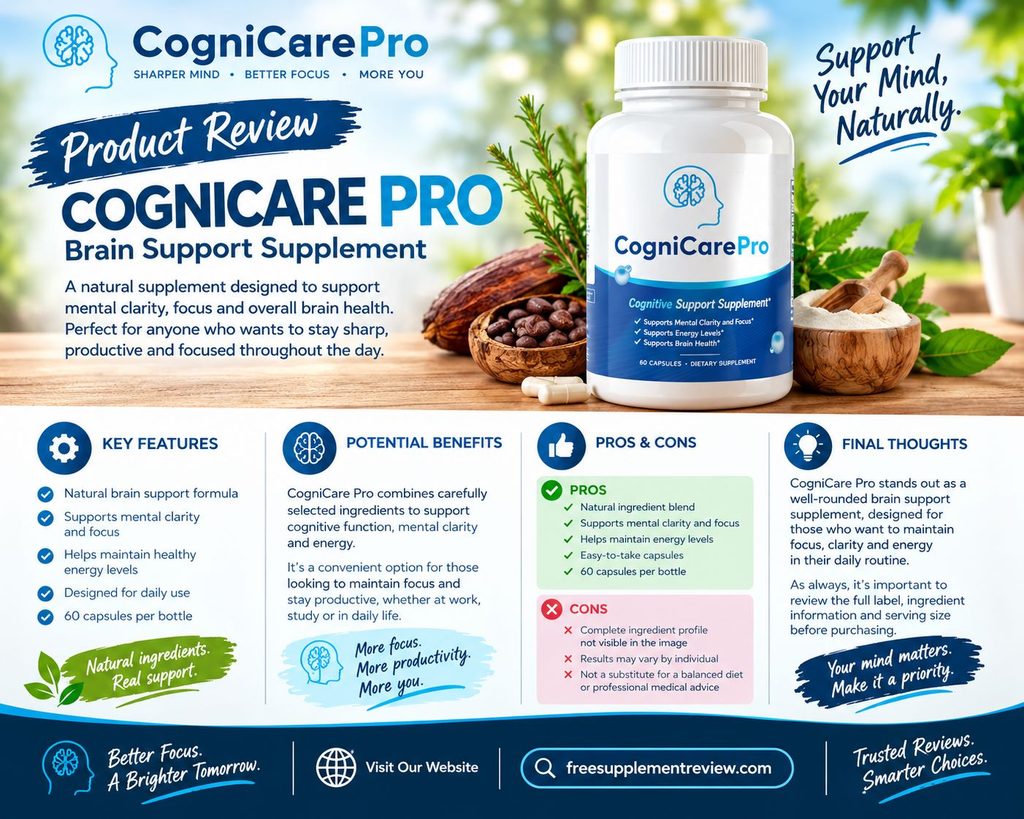
The bottle calls CogniCare Pro a “cognitive support supplement” that supports mental clarity and focus, energy levels, and brain health, each followed by the usual asterisk. The artwork shows a cacao pod, a sprig of club moss, a flowering herb, and a wooden scoop of white powder, hinting at the ingredients. Pages describe a 90-day guarantee and an “eleven-ingredient” formula, though the exact amounts are never clearly shown anywhere I could find.
- Positioning: a non-prescription “nootropic” for memory, focus, and mental energy
- Guarantee: a 90-day money-back policy, according to several pages
- Maker: one page credits a “cognitive health expert” named Elizabeth Bennett, but I could not verify that person
- Missing from the image: a legible Supplement Facts panel with milligram amounts
The Rice Flour Problem in CogniCare Pro Ingredient Lists
One review says rice flour “optimizes blood flow to the brain.” That is a red flag. Rice flour is normally a filler used to fill capsules, not an active ingredient with any known effect on circulation. Other pages mention ginkgo biloba, Huperzia serrata, and L-tyrosine, which are very different compounds. When sources cannot agree on what is inside, and one assigns a medical benefit to a filler, none of the lists can be trusted without the real label.
The plants drawn on the bottle suggest a more familiar nootropic recipe: cacao for flavanols, Huperzia serrata for huperzine A, and Bacopa for memory support. That is plausible, but plausible is not proven. Without doses, you cannot tell whether each ingredient reaches the amount used in research. A formula that lists eleven ingredients and hides the quantities may contain a pinch of everything, and a pinch rarely does anything measurable.
Clues That the CogniCare Pro Reviews Were Mass-Produced
Some of the strangest pages carry titles such as “CogniCare Pro Reviews (Pleased with Durability).” Supplements do not have durability. That wording comes from templates built for hardware products, and it proves nobody read the page before publishing it. Other pages stuff in search phrases like “CogniCare Pro weight loss,” which has no connection to a brain formula, and one text says the product “has side effects” and then calls it “well tolerated.”
The hosting tells the same story. Copies of nearly identical text sit in a college’s form-upload folder, a science organization’s event files, a community discussion board, a crypto jobs site, and newspaper-style “calendar” pages. Many include tracking-style links such as “go/” redirects, and every paragraph repeats the product name. Claims like “clinically tested” or “backed by science” never cite a study, and a founder biography with no verifiable background is not a credential.
What the Likely Ingredients Can Realistically Do
If the pictured herbs are the real core, each has some research, but not the miracle the headlines imply. Effects tend to be modest, slow, and different from person to person, and several herbs carry interaction risks. The list below is a quick reality check you can use when comparing any brain supplement against its marketing.
- Bacopa monnieri: some trials show small memory gains after eight to twelve weeks, with stomach upset in some users
- Huperzia serrata (huperzine A): acts on acetylcholine and may interact with Alzheimer’s drugs; it can cause nausea, dizziness, or a slow heartbeat
- Ginkgo biloba: mixed evidence for memory, and a possible interaction with blood thinners
- L-tyrosine: may help thinking under acute stress or sleep loss, but not as a daily memory fix
- Cocoa flavanols: linked in small studies to better blood flow and some cognitive measures
The most important point is the second one. Huperzine A is a real pharmacological agent, not a gentle tea. Anyone taking medication for dementia, heart rhythm, asthma, or seizures should talk to a doctor before trying a product that contains it. Natural does not mean harmless, and a supplement that truly affects the brain deserves the same respect as a medicine.
Smarter Steps Before Buying CogniCare Pro
You can protect yourself in about ten minutes. Confirm the official website, find the full Supplement Facts panel, and look for a physical address for the manufacturer. If the page hides amounts, offers a countdown timer, or pushes you toward large bundles, step back. A single bottle is enough for a fair test, and your own notes will tell you more than any testimonial.
- Ask for the milligram amount of every ingredient and compare it with published research
- Take the label to a pharmacist and check interactions with your medication
- Screenshot the checkout page, guarantee terms, and any subscription enrollment
- Track focus, sleep, and mood for eight to twelve weeks, and stop if side effects appear
- Rule out basics first: sleep, stress, thyroid, vitamin B12, depression, and medication effects
This article is for informational purposes only and is not medical advice. Consult a healthcare provider before starting any brain supplement, especially if you take prescription medication or have noticed ongoing memory changes.
Frequently Asked Questions About CogniCare Pro
What is in CogniCare Pro? Sources disagree, mentioning Huperzia serrata, ginkgo, L-tyrosine, and even rice flour as a “blood flow” ingredient, so verify the official Supplement Facts panel.
Is CogniCare Pro clinically proven? I found no published trial of the finished formula. Some individual herbs have small studies, which is not the same thing.
Can CogniCare Pro interact with medication? Possibly. Huperzine A and ginkgo can interact with certain heart, dementia, and blood-thinning drugs, so ask a pharmacist first.
Are the online reviews reliable? Many are copied, template-generated pages with unverifiable claims, so treat them as advertising and look for independent sources.
Have you tried CogniCare Pro or a similar nootropic, and did you notice any change in memory or focus after a couple of months? Share your experience in the comments, and tell me if you would like a future post comparing the real research behind Bacopa, ginkgo, and L-tyrosine.